
Launched, Celebrated, Forgotten: A Critical Review of Why Digital and AI-Enabled Agriculture Platforms Fail, Stall, or Survive in East Africa
Abstract
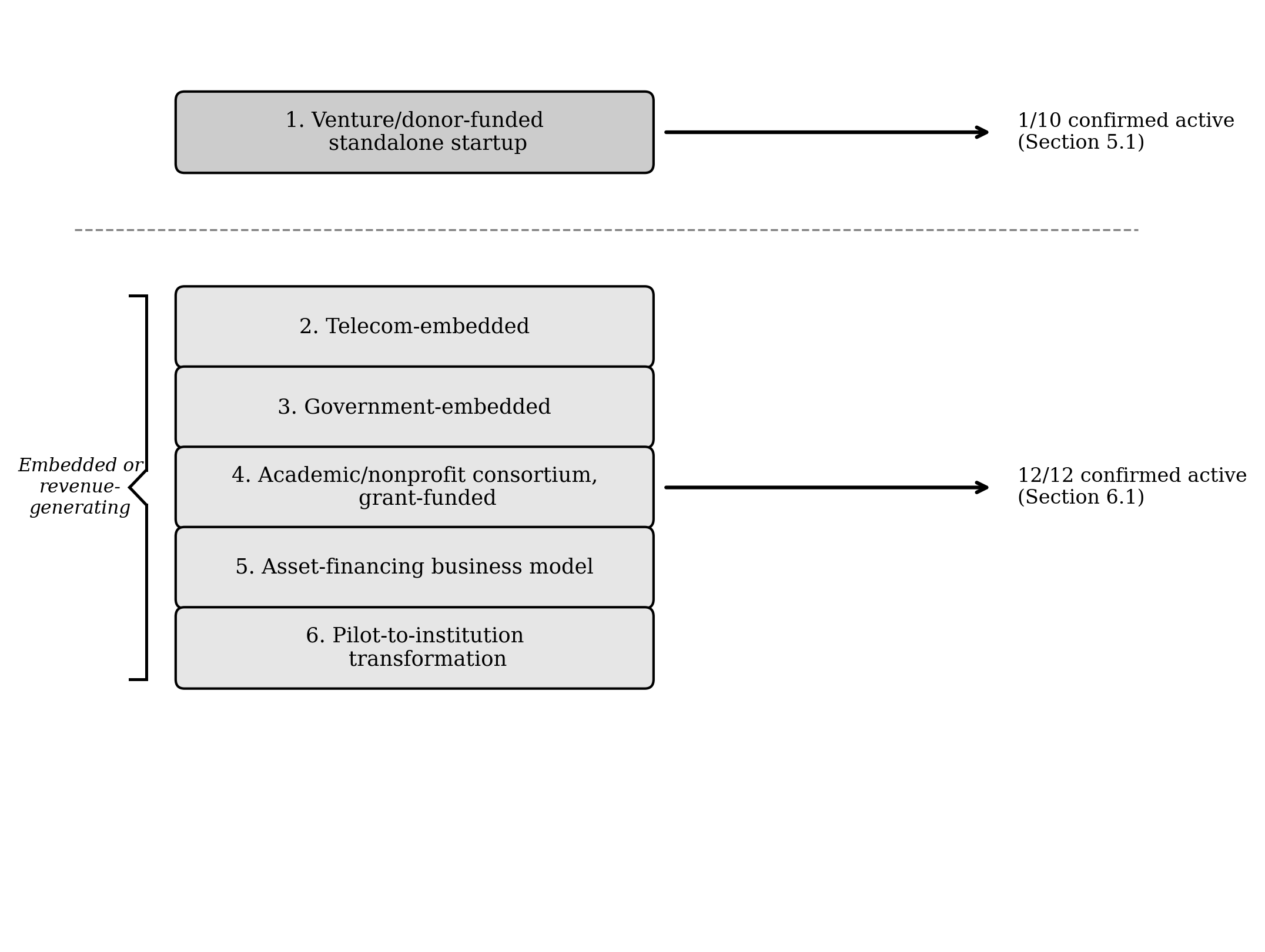
East Africa is frequently framed as a global frontier for digital and AI-enabled agriculture, yet no systematic record tracks what actually happens to widely publicized platforms three to ten years after launch. Combining structured literature synthesis with primary evidence verification across 22 named digital agriculture platforms operating in Kenya, Uganda, Rwanda, Tanzania, and Ethiopia between 2009 and 2026, we audit operational survival against independent primary records rather than self-reported user totals. We observe a sharp institutional divergence: venture- or donor-funded standalone startups exhibit high attrition (only 1 of 10 confirmed active at scale, with documented shutdowns and severe organizational crises), whereas all 12 platforms embedded inside mobile network operators, public agricultural extension systems, asset-financing models, or sustained academic-nonprofit consortia remain active. We formulate a six-model institutional survival taxonomy alongside mandatory post-launch accountability reporting standards.
Key Findings & Contributions
- Builds the first verified longitudinal ledger of 22 named East African digital and AI agricultural platforms (2009-2026) evaluated against primary operational records rather than launch press releases.
- Quantifies the institutional survival gap: 10% confirmed active survival among standalone VC/donor startups (1/10) versus 100% continuity across institutionally embedded platforms (12/12).
- Documents pervasive data-transparency deficits where conflicting sources disagree on whether prominent farmer platforms remain operational, recommending funder-mandated longitudinal outcome reporting.
Benchmark Results
Institutional Survival Breakdown Across 22 Verified East African AgTech Platforms (2009-2026)
| Institutional Embedding Archetype | Survival Characteristic | Core Driver |
|---|---|---|
| Standalone Venture / Donor Startup | 1 / 10 confirmed active | Post-grant valley of death & low smallholder SaaS willingness-to-pay |
| Telecom-Embedded Services | Confirmed sustained | Bundled zero-rated distribution & carrier billing |
| Government Extension / Subsidy Registry | Confirmed sustained | Recurring public budget & mandatory farmer enrollment |
| Asset-Financing & Input Bundling | Confirmed sustained | Direct credit/input margin recovers digital platform cost |
| Research Consortium & Institutional Transition | Confirmed sustained | Multi-cycle grant continuity & public data integration |
BibTeX
@misc{nyalala2026agtech_survival,
  title={Launched, Celebrated, Forgotten: A Critical Review of Why Digital and AI-Enabled Agriculture Platforms Fail, Stall, or Survive in East Africa},
  author={Nyalala, Innocent},
  year={2026},
  note={Manuscript under peer review}
}Nyalala, I. (2026). Launched, Celebrated, Forgotten: A Critical Review of Why Digital and AI-Enabled Agriculture Platforms Fail, Stall, or Survive in East Africa [Manuscript under peer review].