
Between Promise and Practice: Institutional Drivers and Barriers to Digital Transformation in Sub-Saharan African Smallholder Agriculture
Abstract
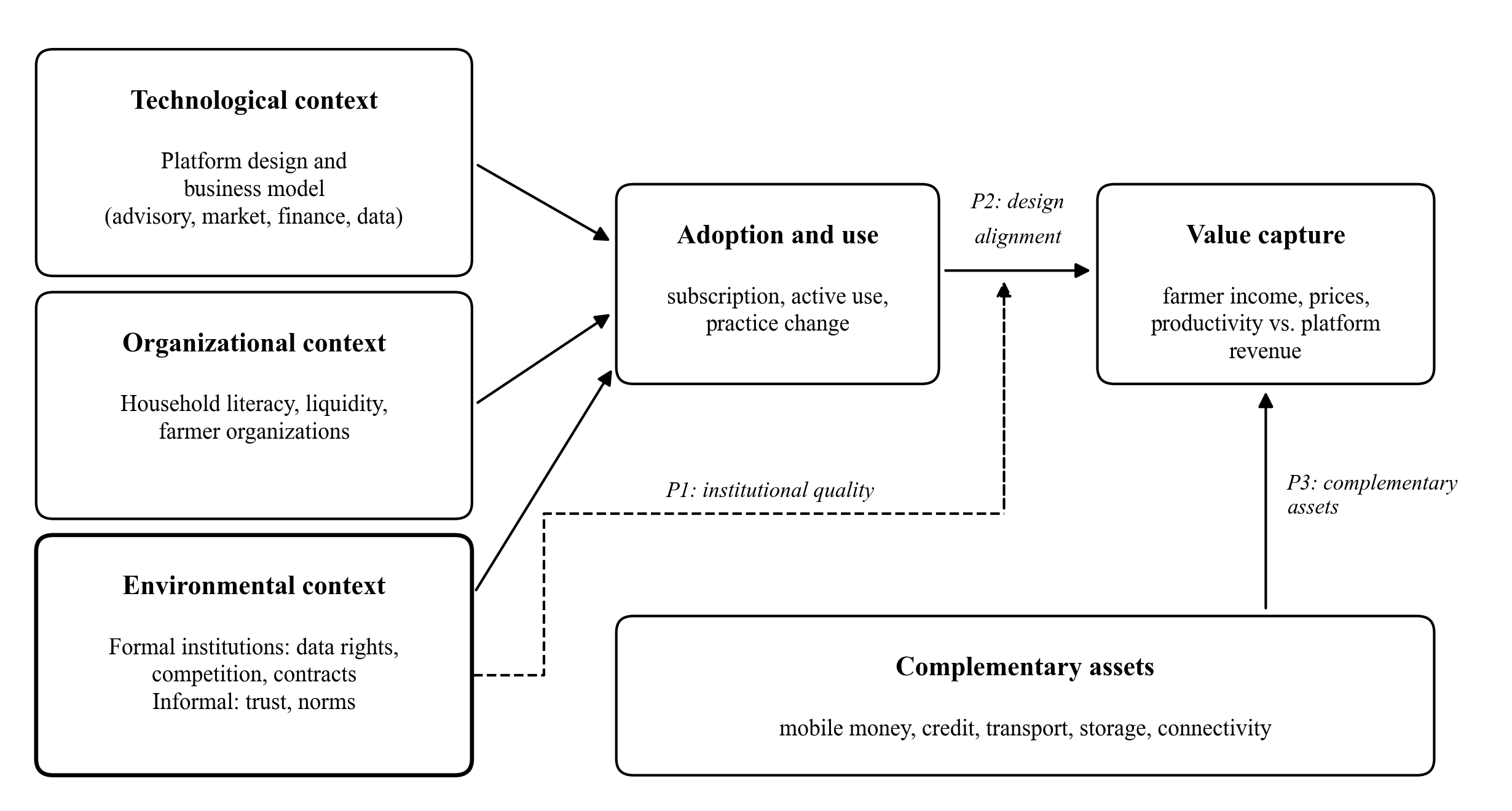
Digital transformation has emerged as a central pillar of agricultural development strategy in Sub-Saharan Africa, where agriculture employs over 60% of the workforce, yet translation into sustained value for smallholder farmers operating under two hectares remains uneven. Drawing on the Technology-Organization-Environment (TOE) framework and institutional voids theory across Ethiopia, Kenya, and Tanzania, we synthesize empirical evidence on mobile advisories, AI diagnostics, and market linkages. While controlled interventions demonstrate conditional yield gains up to 25% and income gains of 200 to 600 USD per hectare, most initiatives fail to scale due to weak institutional coordination, digital literacy gaps, fragmented data ecosystems, and extractive platform incentives. Sustainable adoption requires deliberate institutional co-evolution combining connectivity policy, inclusive platform design, and cooperative farmer governance.
Key Findings & Contributions
- Integrates Technology-Organization-Environment (TOE) adoption determinants with institutional voids theory across smallholder farming systems in Kenya, Tanzania, and Ethiopia.
- Reconciles stark divergence between pilot-level yield/income gains (up to 25% yield; $200-$600/ha) and macro-scale stalling when credit, input markets, and cooperative trust are absent.
- Proposes four policy propositions centering smallholder cooperative governance, rural connectivity subsidies, and interoperable public agricultural data standards.
Benchmark Results
TOE & Institutional Voids Proposition Matrix for Sub-Saharan African Digital Agriculture
| TOE Dimension | Observed Structural Barrier | Institutional Co-Evolution Policy |
|---|---|---|
| Technological Readiness | High feature-phone share & English-only UI | Local Swahili/dialect voice UI & offline edge models |
| Organizational Governance | Extractive platform revenue extracting trader margins | Cooperative data trusts & smallholder revenue-share |
| Environmental & Credit Voids | AI advice unusable without fertilizer/input access | Bundle agronomic advisories with cooperative credit & markets |
BibTeX
@misc{nyalala2026institutional_drivers,
  title={Between Promise and Practice: Institutional Drivers and Barriers to Digital Transformation in Sub-Saharan African Smallholder Agriculture},
  author={Nyalala, Innocent},
  year={2026},
  note={Manuscript under peer review}
}Nyalala, I. (2026). Between Promise and Practice: Institutional Drivers and Barriers to Digital Transformation in Sub-Saharan African Smallholder Agriculture [Manuscript under peer review].