
AI4EAC / EAC STI 2026 Competitive Travel Grant Award , EAC STI 2026, Kigali Published · Travel Grant ($980)
Deep Learning Feasibility Study for Automated Clove Quality Classification Using CNN Architectures on a Novel Zanzibar Dataset
1School of Engineering and Science, Indian Institute of Technology Madras Zanzibar, Tanzania
2Wadhwani School of Data Science and AI (WSDSAI), Indian Institute of Technology Madras, Chennai, India
4th EAC STI Conference / AI for East Africa Conference (AI4EAC 2026), Kigali, Rwanda (Mar 2026)
Abstract
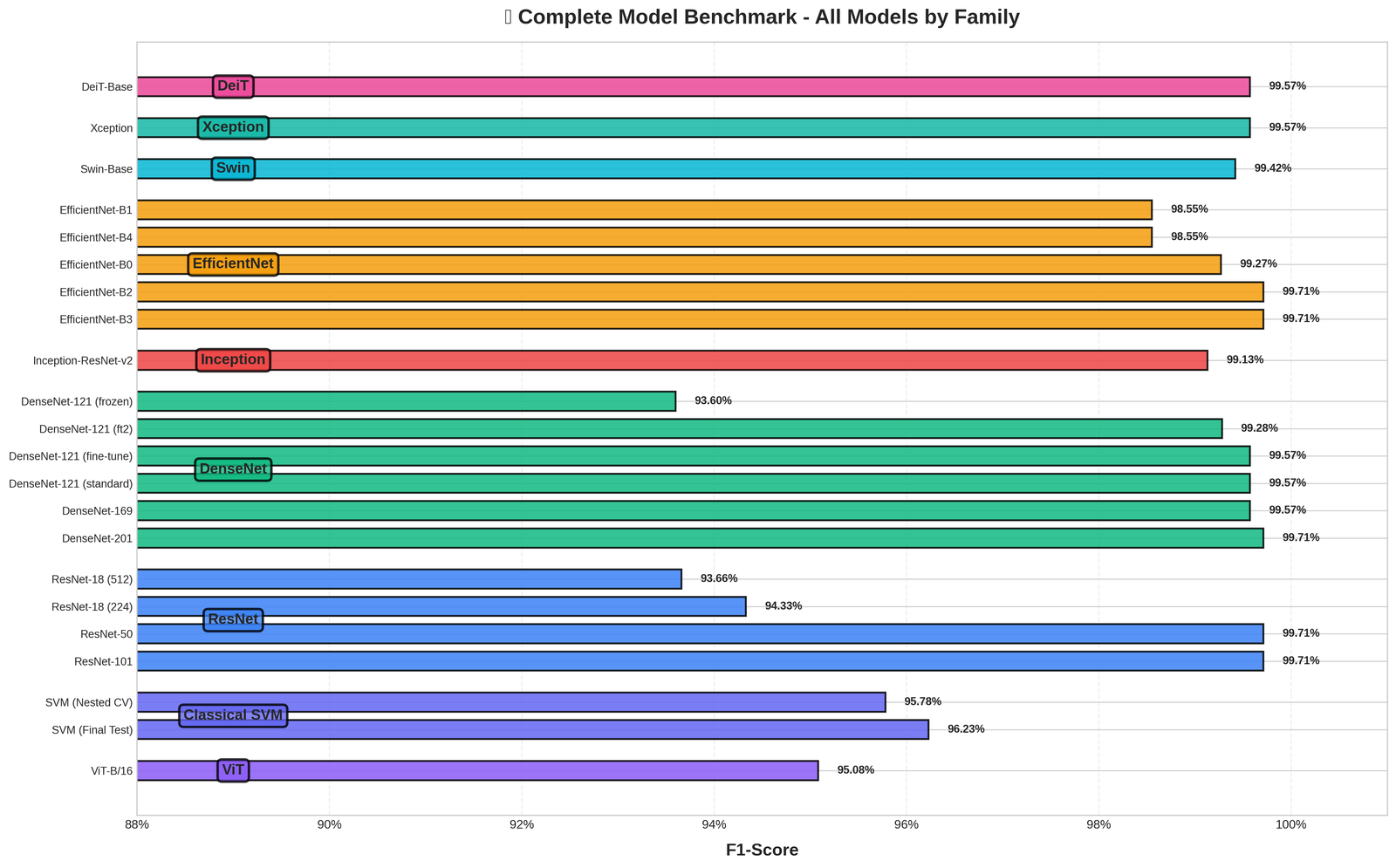
We investigate the technical feasibility of automated clove quality grading using deep learning on ZSTC-Clove-V1, a novel dataset of 5,298 single-clove images across four official commercial grades collected at the Zanzibar State Trading Corporation (Saateni warehouse, Unguja). ResNet-18 achieves 94.46% accuracy (94.33% F1), whereas VGG-16 fails to converge at 31.32%, demonstrating sharp architectural sensitivity on fine-grained agricultural commodities and underscoring the need for trustworthy deployment.
Keywords: ZSTC-Clove-V1clove gradingZanzibarResNet-18East AfricaAI4EAC
Key Findings & Contributions
94.46%
ResNet-18 Accuracy
94.33% Macro-F1
31.32%
VGG-16 Collapse
14.94% F1 (residual need)
5,298
Single-Clove Images
4 ZSTC grades · Saateni, Unguja
$980
EAC Travel Grant
4th EAC STI Conference
- Constructed ZSTC-Clove-V1, a 5,298-image single-clove benchmark graded by certified Zanzibar State Trading Corporation (ZSTC) inspectors (Grade I: 1,455; Grade II: 1,320; Grade III: 1,398; Grade IV: 1,125) under 70/15/15 stratified splits (kappa = 0.87).
- Empirically demonstrated dramatic architectural divergence on fine-grained spice surfaces: residual connections enable ResNet-18 to reach 94.46% accuracy and 94.39% precision, whereas plain VGG-16 fails to converge (31.32% accuracy, 14.94% F1).
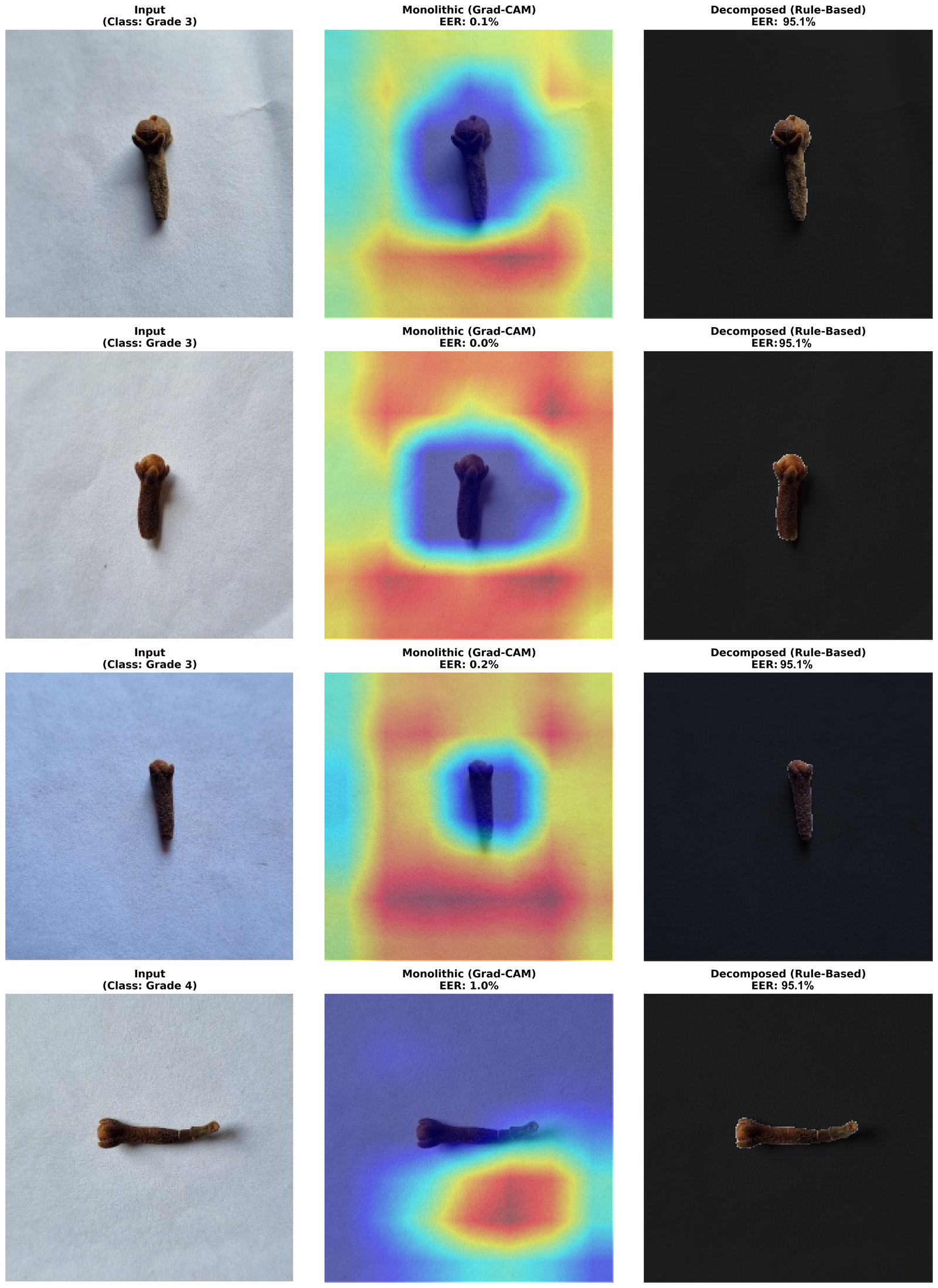
- Analyzed spatial Grad-CAM attributions showing why pure black box classifiers risk latching onto background tray cues rather than botanical bud discoloration (mpeta), directly motivating subsequent segmentation-first grading systems.
Key Empirical Figure
Benchmark Results
CNN Architecture Feasibility Comparison on ZSTC-Clove-V1 Held-Out Test Split (n = 794)
| Architecture | Test Accuracy (%) | Precision (%) | Recall (%) | Macro-F1 (%) |
|---|---|---|---|---|
| ResNet-18 | 94.46 | 94.39 | 94.34 | 94.33 |
| VGG-16 | 31.32 | 9.81 | 31.32 | 14.94 |
ZSTC-Clove-V1 Stratified Dataset Partition Across Commercial Grades (N = 5,298)
| ZSTC Grade | Quality Tier | Total Images | Train (70%) | Val (15%) | Test (15%) |
|---|---|---|---|---|---|
| Grade I | Premium Golden / Crown | 1,455 | 1,019 | 218 | 218 |
| Grade II | Standard Commercial | 1,320 | 924 | 198 | 198 |
| Grade III | Lower Faded Grade | 1,398 | 979 | 210 | 209 |
| Grade IV | Mpeta / Defective | 1,125 | 787 | 169 | 169 |
| Total | All 4 Commercial Grades | 5,298 | 3,709 | 795 | 794 |
BibTeX
@inproceedings{ndowo2026zstcclove,
  title={Deep Learning Feasibility Study for Automated Clove Quality Classification Using CNN Architectures on a Novel Zanzibar Dataset},
  author={Ndowo, Patrick Vincent and Nyalala, Innocent},
  booktitle={AI for East Africa Conference (AI4EAC) / 4th EAC STI Conference},
  address={Kigali, Rwanda},
  year={2026},
  url={https://github.com/saaillab/zstc-clove-v1}
}
APA Citation
Ndowo, P. V., & Nyalala, I. (2026). Deep Learning Feasibility Study for Automated Clove Quality Classification Using CNN Architectures on a Novel Zanzibar Dataset. AI for East Africa Conference (AI4EAC / EAC STI), Kigali, Rwanda.