
When Synthetic Data Hurts: DCGAN Augmentation Failure Under Extreme Data Scarcity for Cassava Disease Classification in East Africa
Abstract
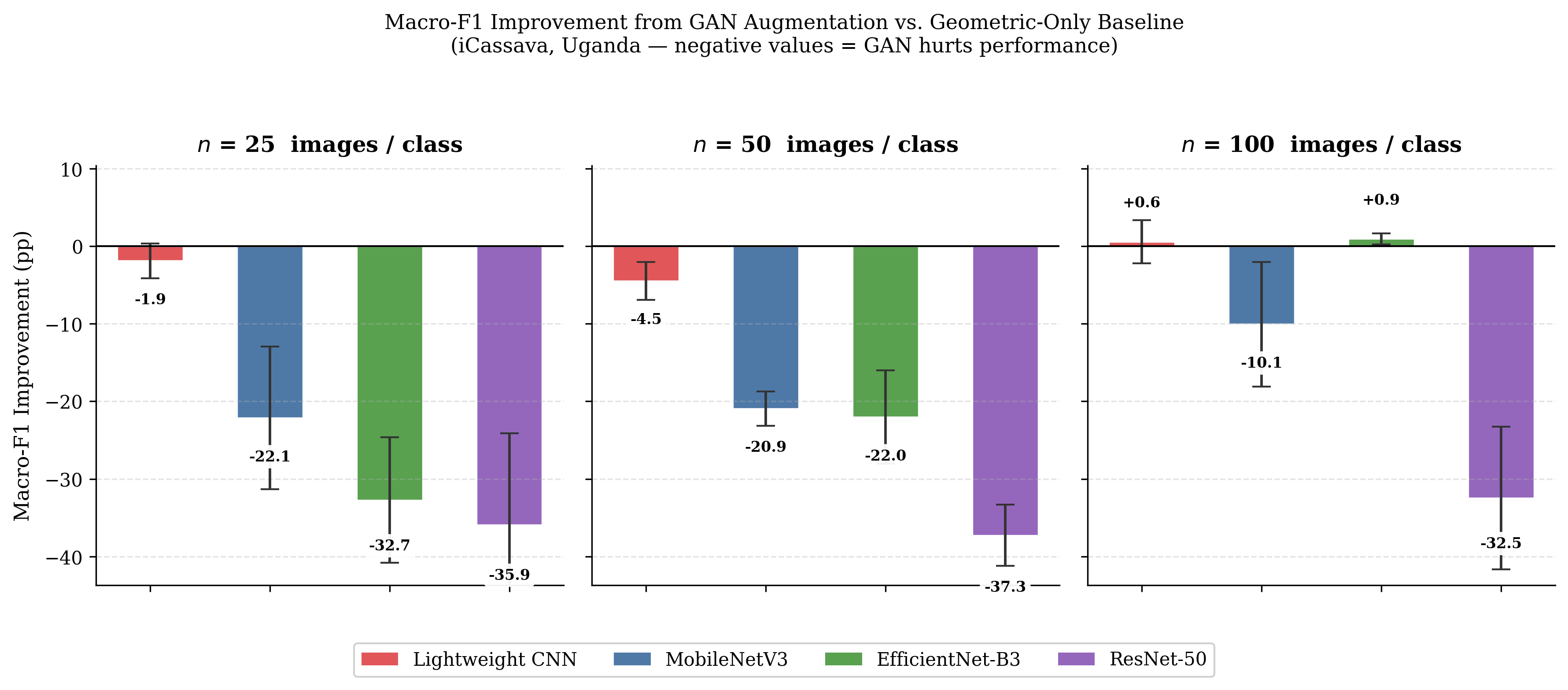
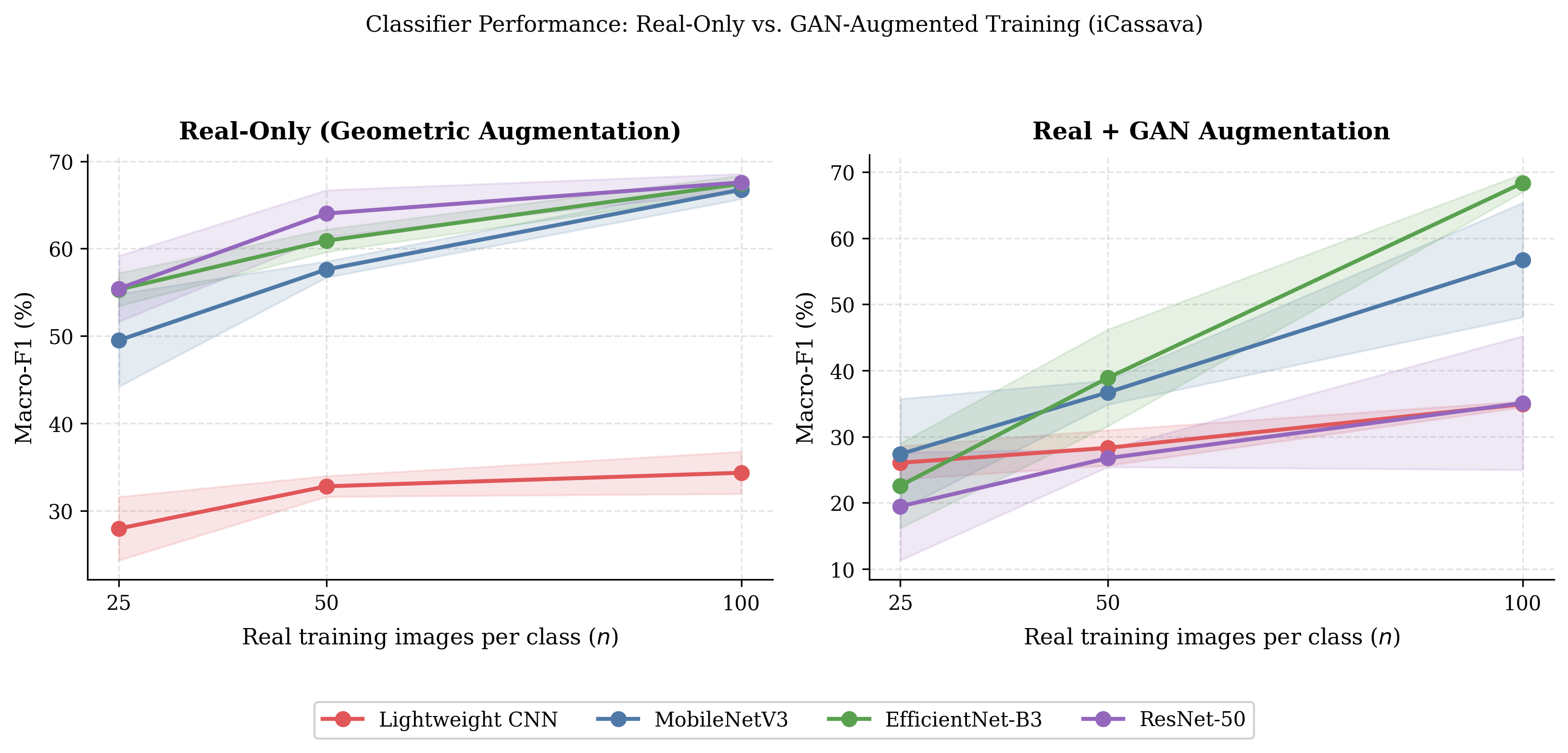
We test whether DCGAN augmentation alleviates labeled-data scarcity for cassava disease classification in Uganda. Training a DCGAN on 25, 50, or 100 real images per class and augmenting four classifier architectures to 500 images per class, we find that GAN augmentation consistently degrades macro-F1: by 23.2 pp at n = 25, 21.2 pp at n = 50, and 10.3 pp at n = 100. Pretrained classifiers suffer far more (ResNet-50: -35.9 pp; EfficientNet-B3: -32.7 pp) than a from-scratch CNN (-1.9 pp). GAN diagnostics confirm discriminator dominance and mode collapse, producing semantically empty images that poison fine-tuning. Within the unregularised DCGAN framework studied, these results establish an empirical minimum viability threshold of roughly 100-200 images per class and counsel caution against synthetic GAN augmentation in extreme few-shot African agricultural datasets.
Key Findings & Contributions
- Conducted 45 controlled DCGAN augmentation runs across three low-shot regimes (n = 25, 50, 100 real images/class) and four classifiers on Ugandan field cassava pathology.
- Demonstrated that unregularized DCGAN augmentation reduces macro-F1 by an average of 23.2 pp at n = 25, 21.2 pp at n = 50, and 10.3 pp at n = 100 compared with geometric augmentation alone.
- Identified asymmetric harm to ImageNet-pretrained backbones (-35.9 pp ResNet-50, -32.7 pp EfficientNet-B3) due to discriminator dominance and semantic mode collapse (lossD near 0.000, lossG spiking to 44.5).
Key Empirical Figure
Benchmark Results
Macro-F1 Delta (pp) from DCGAN Augmentation vs. Geometric-Only Baseline (3 Seeds)
| Classifier | n = 25 imgs/cls | n = 50 imgs/cls | n = 100 imgs/cls |
|---|---|---|---|
| Lightweight CNN (scratch) | -1.9 ± 2.2 | -4.5 ± 2.4 | +0.6 ± 2.8 |
| MobileNetV3 | -22.1 ± 9.2 | -20.9 ± 2.2 | -10.1 ± 8.0 |
| EfficientNet-B3 | -32.7 ± 8.1 | -22.0 ± 6.0 | +0.9 ± 0.7 |
| ResNet-50 | -35.9 ± 11.8 | -37.3 ± 4.0 | -32.5 ± 9.2 |
| 4-Model Mean | -23.2 ± 15.4 | -21.2 ± 13.4 | -10.3 ± 15.7 |
BibTeX
@inproceedings{ndowo2026dcgan,
  title={When Synthetic Data Hurts: DCGAN Augmentation Failure Under Extreme Data Scarcity for Cassava Disease Classification in East Africa},
  author={Ndowo, Patrick and Nyalala, Innocent and Haji, Khamis},
  booktitle={Data Science Africa (DSA) 2026 Workshop},
  address={Makerere University, Kampala, Uganda},
  year={2026},
  month={July},
  note={Oral Presentation}
}Ndowo, P., Nyalala, I., & Haji, K. (2026, July). When Synthetic Data Hurts: DCGAN Augmentation Failure Under Extreme Data Scarcity for Cassava Disease Classification in East Africa. Data Science Africa (DSA) 2026 Workshop, Makerere University, Kampala, Uganda. (Oral Presentation)