
Few-Shot Transfer Learning for Cassava Leaf Disease Detection Under East African Field Conditions
Abstract
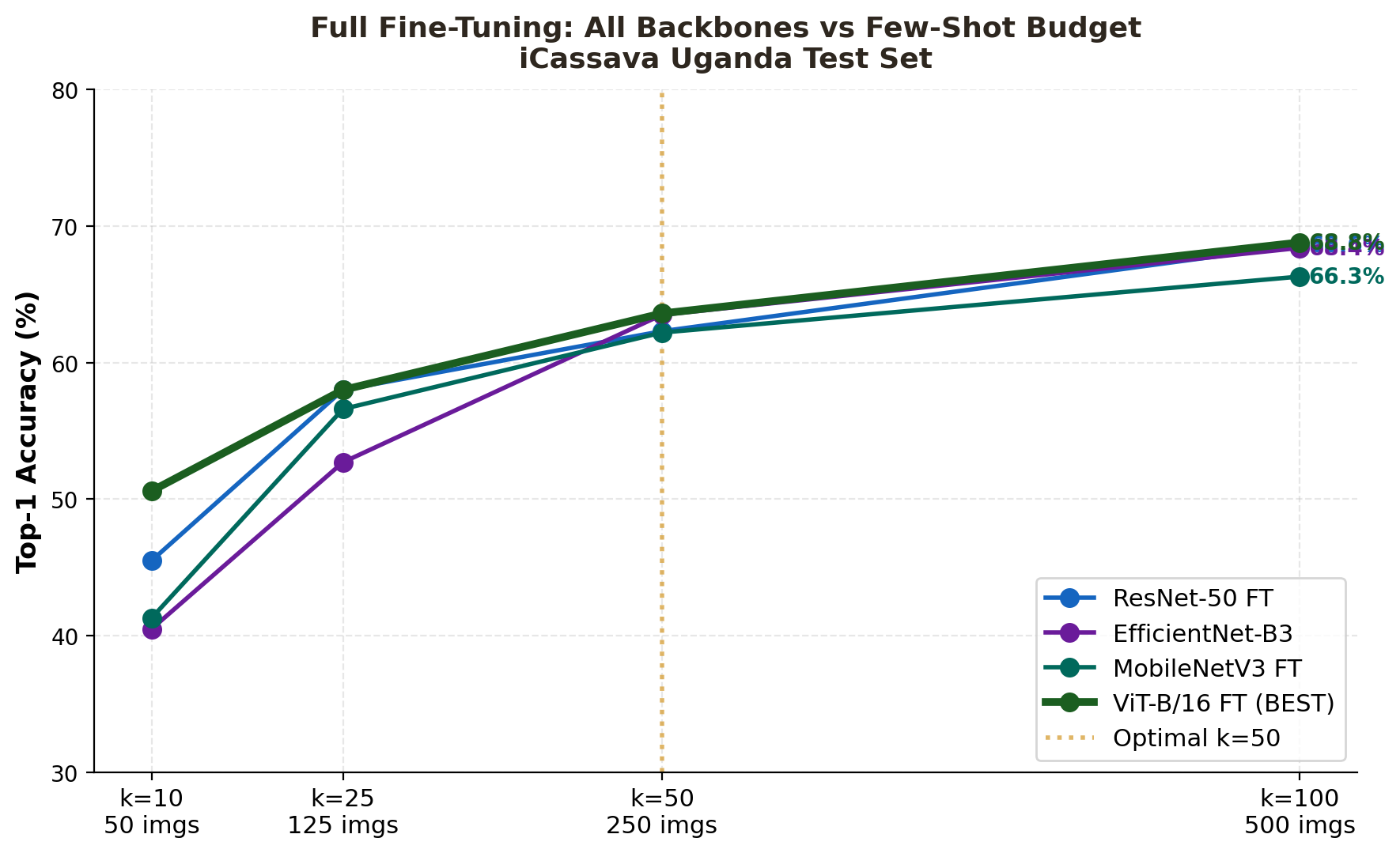
Cassava feeds over 500 million people across Sub-Saharan Africa, yet annual crop losses of up to 40% from Cassava Brown Streak Disease and Cassava Mosaic Disease often go undetected due to scarce diagnostic infrastructure. We present a systematic evaluation of few-shot transfer learning on 21,397 smartphone-captured Ugandan field images spanning five disease classes. Four pretrained backbones (ResNet-50, EfficientNet-B3, MobileNetV3, ViT-B/16) are evaluated under linear probing and full fine-tuning at k in {10, 25, 50, 100} labeled images per class with a shared hyperparameter configuration. Full fine-tuning of ViT-B/16 reaches 63.6% accuracy at k = 50, a +28.5 pp gain over training from scratch.
Key Findings & Contributions
- Evaluated four pretrained backbones (ViT-B/16, EfficientNet-B3, ResNet-50, MobileNetV3) under linear probing vs. full fine-tuning across k in {10, 25, 50, 100} shots/class on 21,397 Ugandan field images.
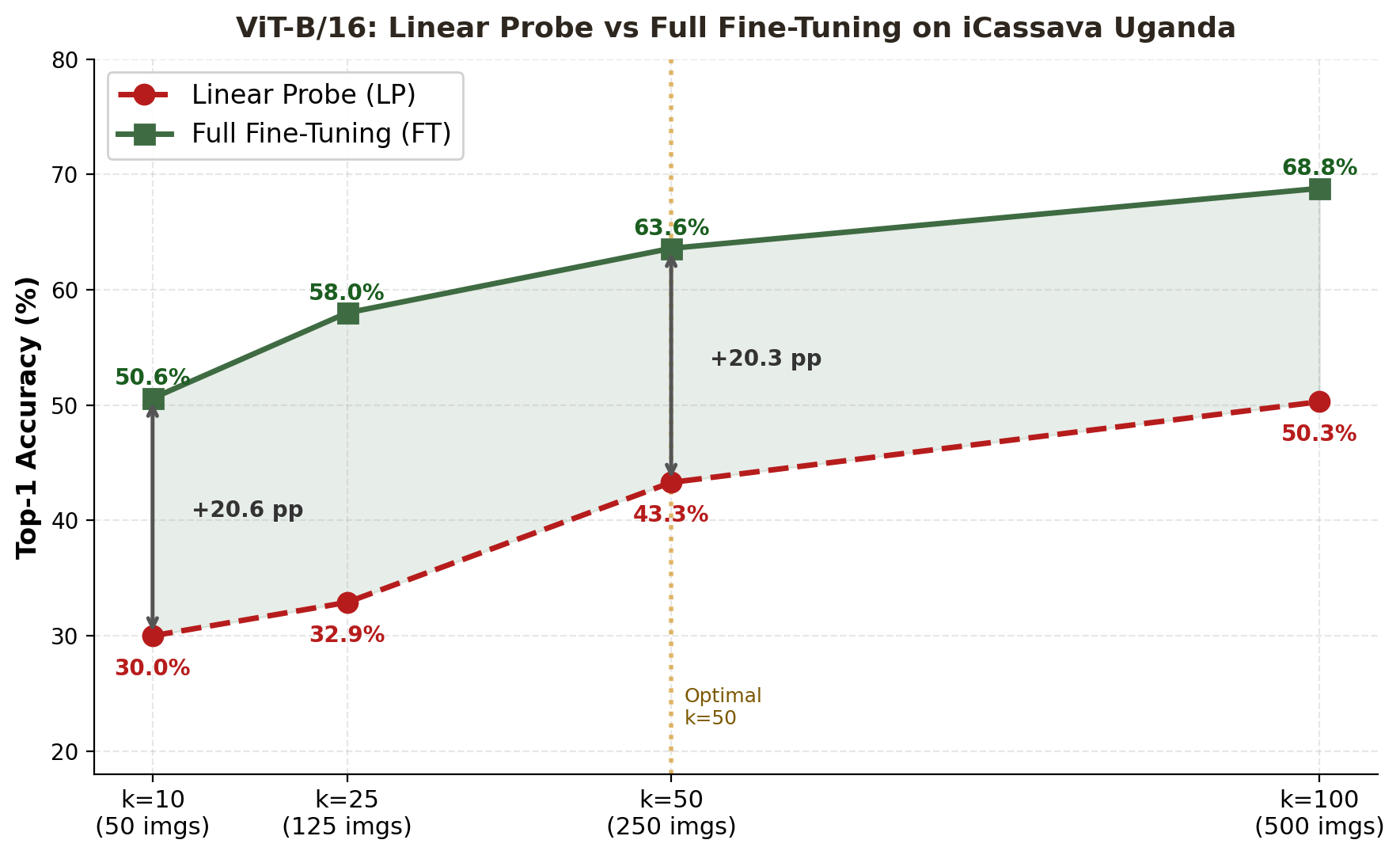
- Demonstrated that full fine-tuning outperforms linear probing by +18 to +20 pp at small k, proving ImageNet features require end-to-end spatial adaptation for field cassava symptoms.
- Identified Healthy leaf confusion (F1: 0.49, 25% misclassified as CBB) vs. CMD (F1: 0.77) and established k = 50 labels/class (250 images total, +0.053 pp/image marginal ROI) as the optimal collection budget.
Key Empirical Figure
Benchmark Results
Few-Shot Top-1 Accuracy (%) on Ugandan Field Cassava (21,397-Image Pool)
| Method & Adaptation | k = 10 | k = 25 | k = 50 | k = 100 |
|---|---|---|---|---|
| ViT-B/16 (Full Fine-Tuning) | 50.6 | 58.0 | 63.6 | 68.8 |
| ResNet-50 (Full Fine-Tuning) | 45.5 | 58.0 | 62.3 | 68.6 |
| EfficientNet-B3 (Full Fine-Tuning) | 40.5 | 52.7 | 63.5 | 68.4 |
| MobileNetV3 (Full Fine-Tuning) | 41.3 | 56.6 | 62.2 | 66.3 |
| ViT-B/16 (Linear Probe only) | 30.0 | 32.9 | 43.3 | 50.3 |
| ResNet-50 (Linear Probe only) | 28.9 | 34.1 | 45.2 | 49.8 |
| Scratch Baseline (No Pretraining) | 26.9 | 32.1 | 35.1 | 39.2 |
BibTeX
@inproceedings{nyalala2026fewshot,
  title={Few-Shot Transfer Learning for Cassava Leaf Disease Detection Under East African Field Conditions},
  author={Nyalala, Innocent and Vincent, Patrick and Vyas, Shivam and Makame, Twamaa and Gudla, Surabhi and Haji, Khamis},
  booktitle={Data Science Africa (DSA) 2026 Workshop},
  address={Makerere University, Kampala, Uganda},
  year={2026},
  month={July}
}Nyalala, I., Vincent, P., Vyas, S., Makame, T., Gudla, S., & Haji, K. (2026, July). Few-Shot Transfer Learning for Cassava Leaf Disease Detection Under East African Field Conditions. Data Science Africa (DSA) 2026 Workshop, Makerere University, Kampala, Uganda.