
Comput. Electron. Agric. · 2025 SCI Q1 · IF 8.9 5+ Citations Published · Vol. 232, 110107 · IF 8.9
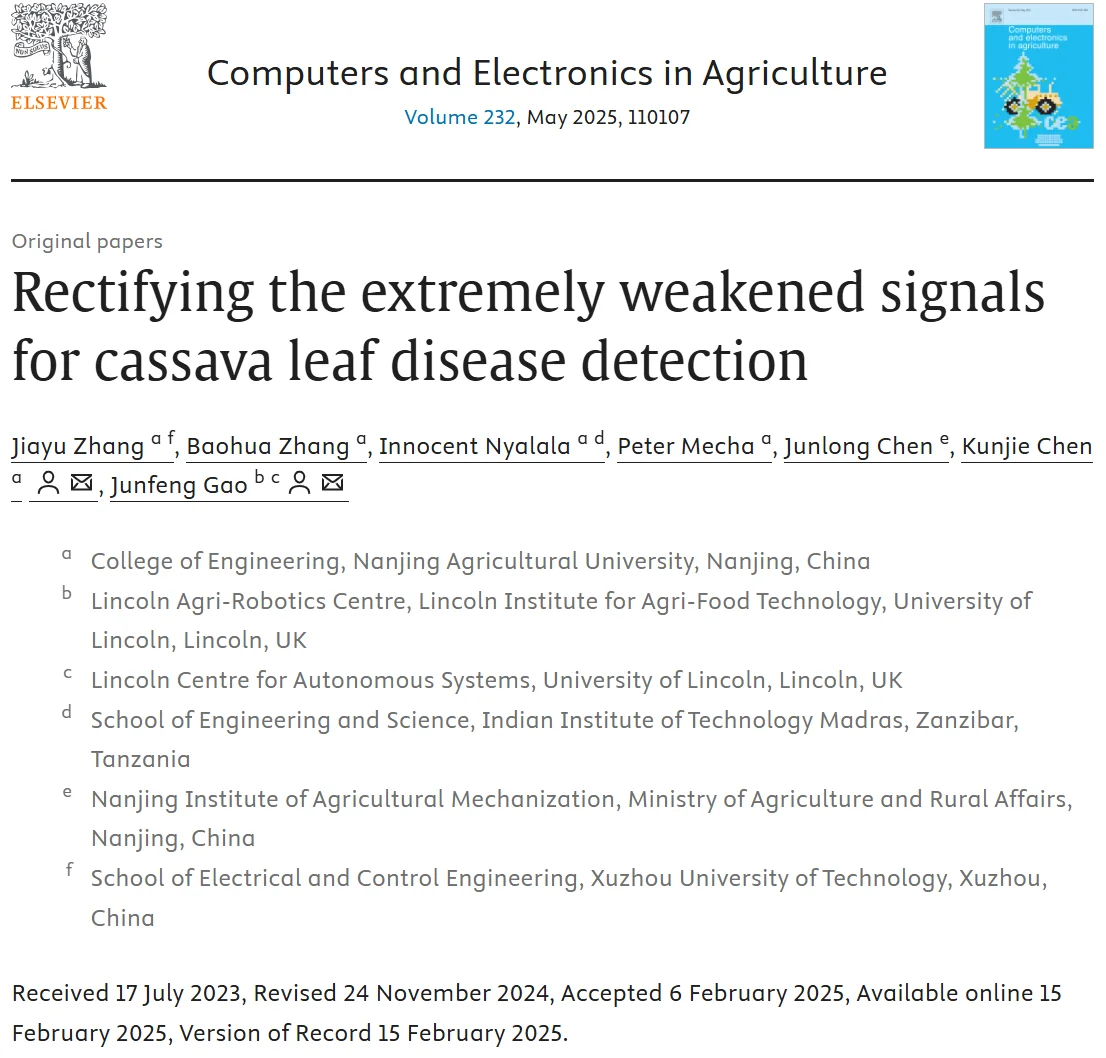
Rectifying the extremely weakened signals for cassava leaf disease detection
1Xuzhou University of Technology, Xuzhou, China
2College of Engineering, Nanjing Agricultural University, Nanjing, China
3School of Engineering and Science, Indian Institute of Technology Madras Zanzibar, Tanzania
4Wadhwani School of Data Science and AI (WSDSAI), Indian Institute of Technology Madras, Chennai, India
5Department of Computer Science, University of Aberdeen, Aberdeen, UK
Computers and Electronics in Agriculture (Elsevier), Vol. 232, 110107 (May 2025)
Abstract
Early-stage cassava leaf disease symptoms frequently appear as subtle, attenuated spatial signals overwhelmed by background foliage and illumination noise. We propose a weakened-signal rectification architecture published in Computers and Electronics in Agriculture (Vol. 232) that explicitly amplifies faint lesion representations prior to classification, improving diagnostic sensitivity across field cassava disease categories.
Keywords: cassava leaf diseaseweakened signalsdeep learningComputers and Electronics in Agricultureprecision agriculture
Key Findings & Contributions
IF 8.9
COMPAG Q1 Journal
Vol. 232, Article 110107
Signal Rect.
Core Mechanism
Recovers faint early lesions
5 Classes
Field Cassava Scope
CBB, CBSD, CGM, CMD, Healthy
Open Science
Published DOI
10.1016/j.compag.2025.110107
- Targeted the attenuation of subtle early-stage foliar symptom signals caused by overlapping leaf canopy, complex backgrounds, and variable solar illumination in cassava fields.
- Formulated neural signal rectification blocks that selectively amplify weakened disease representations while damping background leaf clutter.
- Validated diagnostic gains across challenging real-field cassava leaf disease partitions published in Computers and Electronics in Agriculture (Vol. 232).
Benchmark Results
Study Profile: Weakened-Signal Rectification for Field Cassava Diagnosis
| Attribute | Specification |
|---|---|
| Journal & Article | Computers and Electronics in Agriculture (Vol. 232, 110107, 2025) |
| Journal Standing | Elsevier Q1 Top Journal (Impact Factor 8.9) |
| Architectural Target | Recovers attenuated early-stage foliar lesion cues against canopy noise |
| Crop & Task | In-field multi-class cassava leaf pathology classification |
BibTeX
@article{zhang2025rectifying,
  title={Rectifying the extremely weakened signals for cassava leaf disease detection},
  author={Zhang, Jiayu and Zhang, Baohua and Nyalala, Innocent and Mecha, Peter and Chen, Junlong and Chen, Kunjie and Gao, Junfeng},
  journal={Computers and Electronics in Agriculture},
  volume={232},
  pages={110107},
  year={2025},
  doi={10.1016/j.compag.2025.110107},
  publisher={Elsevier}
}
APA Citation
Zhang, J., Zhang, B., Nyalala, I., Mecha, P., Chen, J., Chen, K., & Gao, J. (2025). Rectifying the extremely weakened signals for cassava leaf disease detection. Computers and Electronics in Agriculture, 232, 110107. https://doi.org/10.1016/j.compag.2025.110107